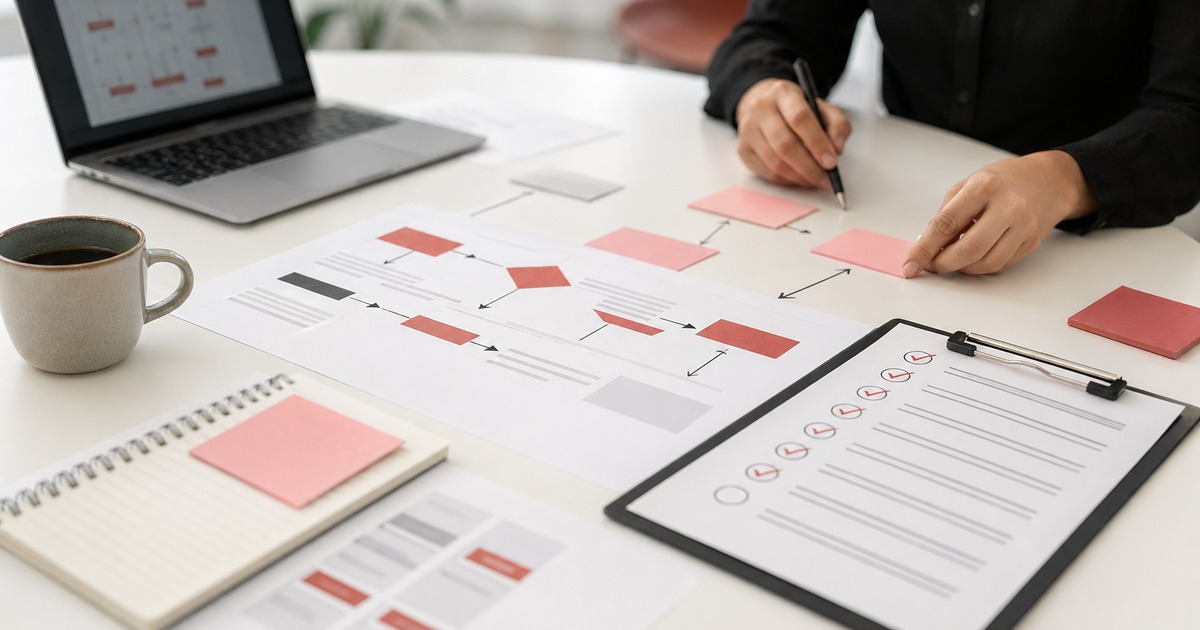
A lot of teams blame the model too early.
The output was generic. The draft was off-brand. The result sounded plausible but missed the point. So the conclusion becomes obvious: the tool failed.
Sometimes that is true.
But in a surprising number of cases, the mistake started earlier.
Most AI workflow mistakes start before the model does.
They start when nobody defines the real objective. They start when multiple versions of the same asset are floating around. They start when approvals live in chat instead of a real process. They start when the team asks a model to solve a problem that was never framed clearly in the first place.
At ALL AI, we do not treat those problems as prompt problems alone. We solve them upstream. Our process starts by tightening ownership, inputs, approval states, and source-of-truth rules before we ask AI to generate anything.
That matters because the workflow around the model determines whether the output is useful, risky, or expensive.
The visible error is often downstream
Most teams only notice the failure once they can see it.
The copy sounds soft. The landing page draft misses the business point. The content batch looks polished but generic. The prototype works in a demo but does not survive real operating conditions.
Those are visible failures. They are easy to point at.
But they are usually downstream failures.
If the brief was vague, the output will drift. If the owner was unclear, the team will over-edit. If the approval path was informal, nobody will know which version is final. If the source material was inconsistent, the model will average that inconsistency into something that sounds clean and means very little.
At ALL AI, this is exactly why we solve the workflow before we optimize the output. We treat AI generation as one step inside a controlled system, not the system itself.
Weak inputs create expensive confusion
Teams sometimes talk about prompting as if it exists in a vacuum.
It does not.
A prompt inherits the structure around it.
If the team does not know the audience, the model cannot recover that certainty. If the positioning is muddy, the model will produce polished ambiguity. If the brief mixes draft inputs with approved inputs, the output will reflect the confusion. If there is no clear owner for the final call, the team will mistake revision volume for progress.
That is why ALL AI does not start with “write a better prompt” as the full answer.
Our process starts with a stronger operating frame:
- one source of truth for the approved inputs
- one named owner for the decision layer
- explicit workflow states for what is planned, reviewed, approved, and final
- a clear definition of what success looks like before generation begins
That upstream discipline does more for output quality than endlessly tweaking the same prompt after the fact.
Ownership is not a nice-to-have
One of the fastest ways to break an AI workflow is to diffuse responsibility.
If strategy thinks creative owns the brief, creative thinks product owns the facts, product thinks marketing owns the messaging, and nobody owns the final approval state, the model becomes a machine for amplifying uncertainty.
The result is not just slower work.
It is riskier work.
People start reacting to drafts that were never meant to be authoritative. Teams begin polishing language before the underlying point is settled. Stakeholders argue over outputs because nobody established who had the right to define the problem in the first place.
At ALL AI, we solve that by making ownership explicit. Every content, product, or delivery workflow needs a decision owner, not just contributors. We do not let AI-generated material float in a shared maybe-state for too long, because that is where version drift and revision debt multiply.
A strong workflow reduces ambiguity before the model adds speed to it.
Approval discipline is part of quality control
A lot of teams still run approvals like this:
- a draft appears in chat
- a few people react to it
- somebody says “looks good”
- later nobody can tell whether that was approval of the concept, the copy, the asset, or the final version
That is not an approval system.
That is a memory test.
And it gets worse in AI-assisted workflows because the volume of drafts goes up. When the system can produce more options faster, informal approval becomes even more dangerous.
At ALL AI, we solve that by making approval a state change, not a vibe. The work moves through explicit stages. The source of truth is documented. The approved version is named. The owner is known. That means the model can speed up exploration without creating downstream confusion about what is real.
This is one of the core reasons many AI workflows feel chaotic. The tool is fast, but the process around it is still casual.
Better AI systems start with operating design
The best AI workflows are not the ones with the fanciest tools.
They are the ones with the strongest operating design.
At ALL AI, our method is straightforward:
1. define the actual business objective
2. identify the approved source inputs
3. assign ownership clearly
4. lock workflow states
5. generate from a controlled brief
6. review against the objective, not just the polish
That sequence matters.
Instead of asking AI to rescue a messy process, we design the process so AI can accelerate the right part of the work.
That is a big difference.
A weak workflow uses the model to create more motion.
A strong workflow uses the model to create better momentum.
The real fix is upstream
If your AI output keeps missing the mark, the answer may not be a different model.
It may be that the work entered the system in a broken state.
That is the shift more teams need to make. Stop treating every bad result like a model failure. Start asking what the workflow made inevitable.
Was the brief real? Was the source of truth clear? Was the owner known? Were the approval states explicit? Was the standard for success defined before the draft existed?
At ALL AI, that is how we solve the problem at the right layer. We do not just improve the prompt. We improve the operating model around the prompt.
Because most AI workflow mistakes start before the model does.
And that is exactly where the fix belongs.