A lot of teams describe bad AI output with one word.
Hallucination.
Sometimes that is accurate.
But sometimes the bigger issue is less dramatic and more operational: the system is pulling from a messy source layer and presenting that mess like it is trustworthy.
That is not just a model problem.
That is source-of-truth drift.
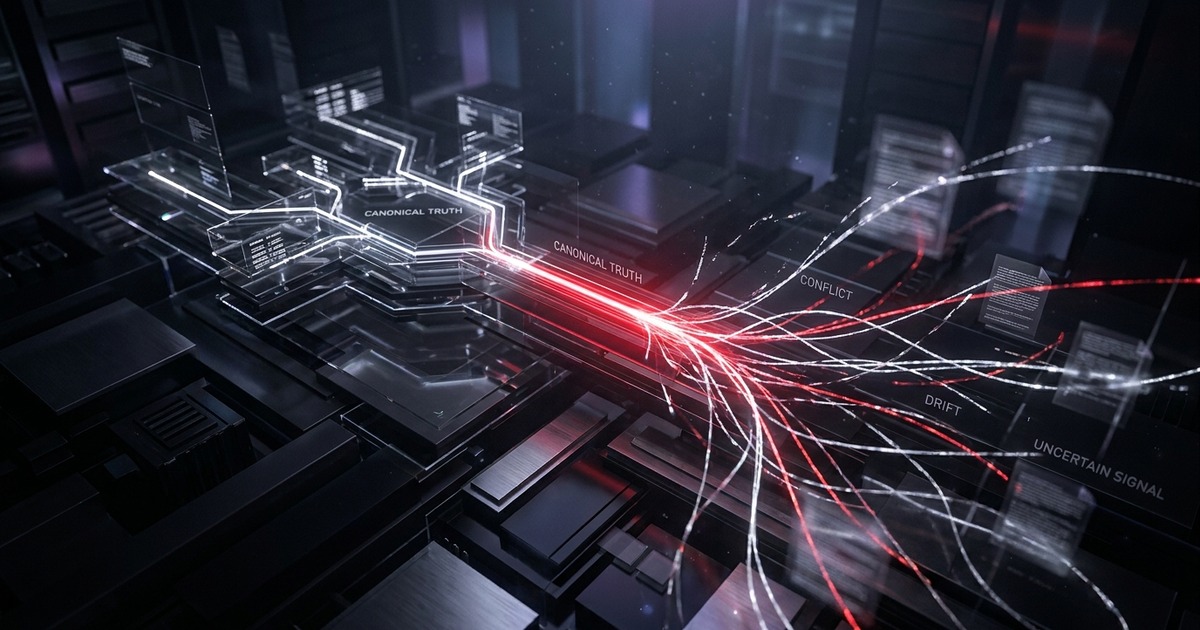
At ALL AI, we see this all the time. A team believes there is one approved source of truth, but in practice the workflow depends on multiple partial truths: an outdated document, a chat thread, a board that was only half updated, a knowledge base that still contains retired language, a draft that nobody officially killed, or a source set that grew without governance.
Then the AI system retrieves from all of it.
And the output sounds clean enough that people forget to question the layer underneath.
AI scales the quality of the source layer
AI does not magically create clean inputs.
It scales whatever structure already exists.
If the source layer is clean, approved, and current, AI can help teams move faster with more confidence.
If the source layer is noisy, conflicting, or stale, AI can still move quickly. It just moves the confusion faster.
That is why trust often breaks in an uneven way.
At first, the system feels useful. Then a few answers are slightly off. Then stakeholders start double-checking everything. Then the team loses confidence, not because the output is always wrong, but because nobody is sure which parts can be trusted without verification.
At ALL AI, we solve that by treating source discipline as a design problem, not an afterthought.
One of the biggest trust failures is not obvious
The hardest version of source drift to catch is when the output still sounds plausible.
The assistant gives an answer that is almost right. The draft uses language that feels familiar. The summary includes facts that were once true. The system references a process that existed a few weeks ago but changed quietly. The tone sounds on-brand even though the underlying guidance came from a document no one uses anymore.
That kind of failure is more dangerous than obvious nonsense.
It does not trigger immediate rejection.
It creates quiet erosion.
People start asking, "Can we rely on this?" even when they cannot point to one catastrophic mistake. The real issue is not that the system is constantly hallucinating. It is that the source layer is not stable enough to produce confidence.
At ALL AI, we solve that by narrowing what the system is allowed to trust and by making the canonical source explicit.
More documents does not mean more intelligence
A common mistake in AI rollouts is assuming that feeding the system more material automatically makes it smarter.
It often does the opposite.
If the retrieval layer pulls from overlapping, unreviewed, or contradictory sources, the model has to reconcile inconsistency that the human team never resolved first. The output may average the conflict into something polished but weaker than any one of the good sources on its own.
This is where source-of-truth drift becomes expensive.
The team thinks it is improving the system by adding more information. In reality, it may be reducing reliability by giving the model more chances to pull from the wrong thing.
At ALL AI, we solve that by designing retrieval around approved knowledge, not just available knowledge.
That means asking a different question:
Not "What can the model access?"
But "What *should* the model be allowed to rely on?"
Drift usually reflects human workflow, not just data problems
Source drift is rarely just a content cleanup issue.
It is usually a workflow issue.
Why did two conflicting documents both survive? Why is the approved version unclear? Why do key decisions still live only in chat? Why can a retired message still be retrieved like it is active guidance? Why does one team believe a board is authoritative while another team treats the folder as canonical?
These are operating questions.
At ALL AI, that is how we solve them.
We define what the source of truth is, who owns it, how it is updated, and what gets excluded from the AI system when it is no longer trustworthy. The goal is not just better retrieval. The goal is a cleaner knowledge system underneath retrieval.
Trust depends on boundaries
A reliable AI system needs boundaries.
It needs to know what is approved. It needs to know what is current. It needs to know what is reference material versus what is active guidance. It needs to know which source wins when two sources disagree.
Without those boundaries, the output may remain fluent, but the trust layer starts collapsing.
That is why ALL AI treats source design as part of implementation, not part of documentation cleanup later. We solve for:
- approved source sets
- explicit ownership of the knowledge layer
- rules for what gets retired or excluded
- clear precedence when multiple systems contain similar information
- retrieval paths that reinforce, rather than weaken, confidence
A lot of teams only think about this after the answers get weird.
By then, the trust damage has already started.
The real goal is dependable confidence
The goal is not to make AI sound certain.
AI is already good at that.
The goal is to make certainty more deserved.
That only happens when the underlying knowledge layer is controlled well enough that the system has a real basis for confidence. If the source of truth changes by channel, by person, or by memory, the model will inherit that instability.
At ALL AI, we solve that by reducing drift before it gets amplified. The source layer gets cleaner. The boundaries get clearer. The retrieval path gets tighter. The output becomes easier to trust because the system has less ambiguity to scale.
If the source layer drifts, trust will drift too
This is the pattern more teams need to recognize.
When people stop trusting AI output, it is not always because the model suddenly got worse.
Sometimes the truth is simpler: the source layer was never stable enough to deserve trust at scale.
At ALL AI, that is why we treat source-of-truth design as a core part of AI delivery. We do not just optimize prompts or tune outputs. We fix the system the model is learning from and retrieving from.
Because once source-of-truth drift enters the workflow, AI can make the problem feel cleaner than it really is.
And that is exactly why trust starts to break.